- Browse all categories
- Best Picks by Swift Karting: The Essential Pit Tools
-
- Brake Bleeder Kit
- Brake Fittings & Ferrules
- Brake Fluid
-
Brake Hubs
- Brake Line
-
Brake Parts (M.C.P.)
-
Brake Rotors
- Caliper Brackets
- Enginetics Parts
- Euro Brake Pads
- Front Wheel Brakes
- Master Cylinder Caps, Billet
- Quarter Midget Brakes
- Rotor Guards
-
- Alfano Gauges & Accessories
- Hour Meter
-
Mychron Gauges
- Stopwatches
- Tach Bags
- Transponder Holders
-
-
Axle Bearings
- Axle Cassettes
-
Axles & Accessories
-
Bully Clutches
-
Chain
- Chain Breaker Tools
- Clutch Drivers
- Clutch Friction Discs
- Clutch Mounting Bolt Kits
- Clutch Spacers
-
Hilliard Clutches
- Honda GXH50 Kid Kart Clutch
-
Horstman Clutch Parts
- Lock Collars
-
Max-Torque Clutches
-
Nor-Am Clutches
-
Premier Clutches
- SMC Kart Clutches
- Sprocket Guards & Hardware
-
Sprocket Hubs
-
Sprockets
-
Viper Clutches
-
-
-
196cc Clone Engine & Parts
-
212cc Clone / Predator Engine & Parts
- 224cc Clone Engine & Parts
- Air Filters & Pre Filters (1.25")
-
Air Filters & Pre Filters (2-7/16")
- Big Block Clone Accessories
-
Briggs LO206 Engines & Parts (LO206)
- Briggs Quarter Midget Engine and Parts
- Briggs World Formula
- Camshafts
- Carb Cover (2-7/8")
- Carb Manifolds
- Catch Tanks
- Chain Guards & Hardware
- Exhaust Header Wrap
- Exhaust Silencers & Clamps
- Flywheel Screens
- Fuel Filters
- Fuel Line
- Fuel Pumps
-
Fuel Tanks
-
Gaskets (Fel-Pro)
- Honda GXH50 Kid Kart
-
Motor Mounts
-
Oil & Additives
- Pulse Fittings
-
Raptor (Flathead) Parts
- Spark Plug Index Washers
- Spark Plugs (2-Cycle & Honda Kid Kart)
- Throttle Cables & Hardware
- Tillotson Carbs
- Wiseco Pistons
-
- Track Wear, Kart Life Apparel

Longacre Racing
Kart Scaling Guide: How to Set Up Accurate Weight Balance Using Longacre Elite Wired Scales (SKU 82624)
Kart Scaling Guide: How to Set Up Accurate Weight Balance Using Longacre Elite Wired Scales (SKU 82624)
Couldn't load pickup availability
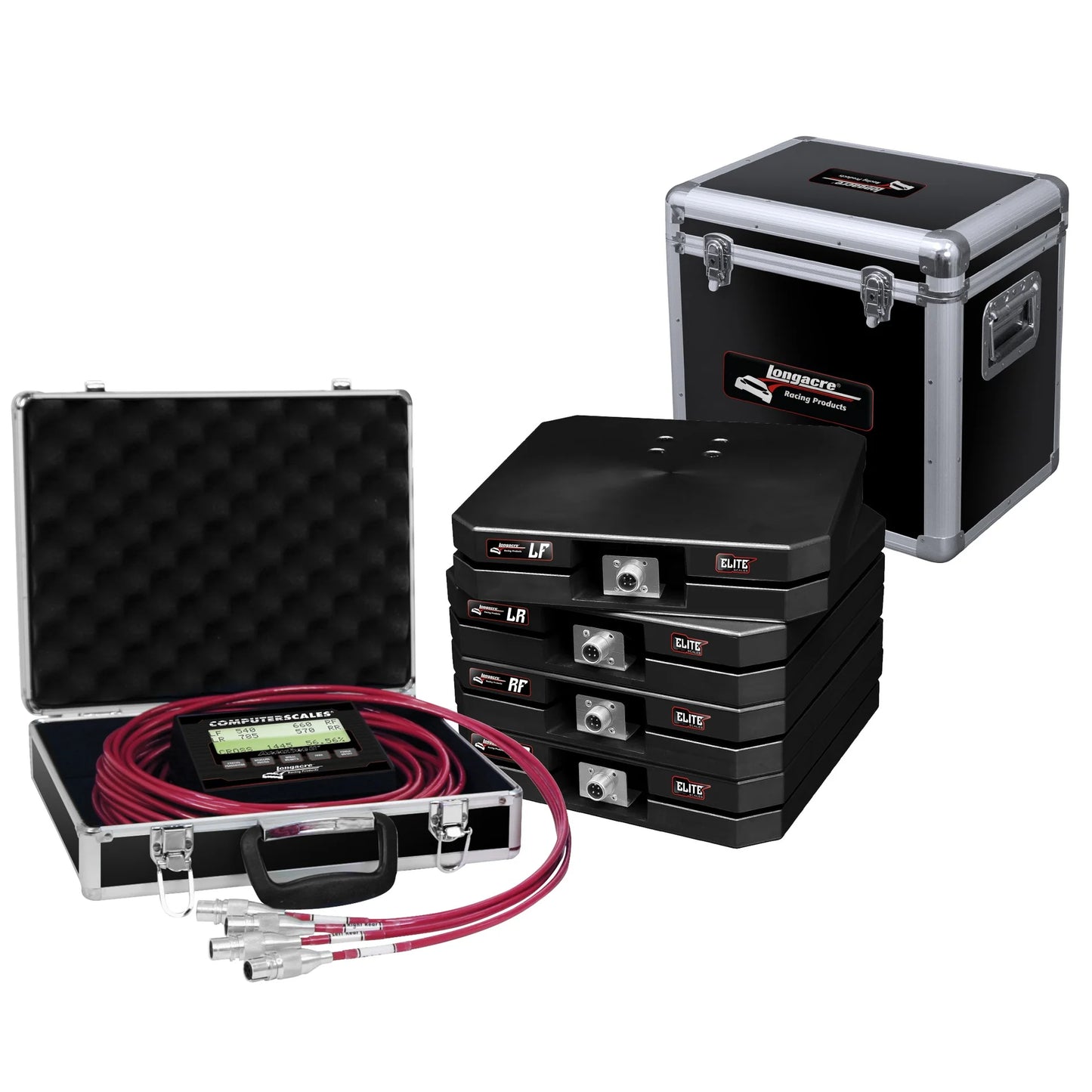
How to Scale a Kart Correctly Using Wired Digital Racing Scales and product guide for Longacre Elite Wire Digital Kart Racing Scales SKU 82624
Model: Longacre Racing Elite Wired Digital Kart Racing Scales for Accurate Weight Distribution
SKU: 82624
Why Scaling Your Kart Matters, a great read... LEARN something while you buy. Great sophisticated howto, nothing left out of this complete guide
Proper scaling is one of the most important steps in developing a kart that is predictable, balanced, and capable of consistent lap times. A kart with correct weight distribution responds more accurately to fine tuning changes, rotates more cleanly at corner entry, and provides the driver with a stable platform under braking and acceleration.
Step 1: Complete Pre Scale Checks
Perform these checks before placing the kart on the scales to ensure accurate and repeatable results.
-
Level the ground
- Use the flattest surface you can find.
- Check level front to back and left to right using a bubble level.
- A kart scaled on uneven ground will give misleading readings.
-
Install all components exactly as raced
- Seat, pods, nose, rear bumper installed.
- Battery, data logger, transponder mounted.
- Ballast installed and tightened.
-
Set tire pressures
- Use your normal cold pressures for that track and compound.
- Check with the same gauge every time.
- Tire pressure affects ride height, which affects scaling numbers.
-
Measure tire diameter and stagger
- Measure rear tire circumference. Note LR and RR difference.
- Match front tires as close as possible.
- Large mismatches create inaccurate corner weights.
-
Verify free movement of all systems
- Spin front wheels to ensure no dragging brakes.
- Check rear axle spins freely and chain is not overly tight.
- Steering must turn smoothly without resistance.
-
Fuel level consistency
- Use the same fuel load every time you scale the kart.
- Half tank or race start amount works best.
-
Driver vs no driver scaling
- For best results, scale with the driver in full gear.
- If scaling without a driver, always note it on your baseline sheet.
Step 2: Setting Up the Longacre Elite Wired Scales
-
Position each pad
- Place pads in a perfect rectangle matching wheelbase and track width.
- All pads must sit flat without rocking.
-
Connect all wired leads
- Connect each pad to the indicator using the labeled left front, right front, left rear, and right rear cables.
- Confirm each channel is reading input.
-
Zero the system
- With all pads empty, press zero on the indicator.
- Confirm all corners read 0.0 before continuing.
Step 3: Placing the Kart on the Scales
- Roll the kart forward so each tire centers perfectly on the pads.
- Confirm nothing is touching the ground except the tires.
- Point the steering wheel straight ahead.
- If scaling with driver:
- Driver must sit in normal posture, back fully in the seat, feet on pedals.
- Driver must stay still to allow readings to stabilize.
- Wait for numbers to settle, then record the four corners and totals.
Step 4: Interpreting the Numbers
The indicator will show:
- LF (left front)
- RF (right front)
- LR (left rear)
- RR (right rear)
- Total weight
- Front percentage
- Rear percentage
- Left percentage
- Right percentage
- Cross weight percentage
Ideal LO206 Baseline Targets
- Front percentage: 42 to 44 percent
- Rear percentage: 56 to 58 percent
- Left percentage: 49 to 51 percent
- Right percentage: within one percent of left
- Cross weight: 49 to 51 percent
Step 5: How to Adjust Weight Distribution
Changing Front and Rear Weight
- Move seat forward → increases front percentage.
- Move seat rearward → increases rear percentage.
- Move ballast forward or rearward for fine tuning.
Changing Left and Right Weight
- Move seat left → increases left side percentage.
- Move seat right → increases right side percentage.
- Shift ballast across centerline for small corrections.
Changing Cross Weight
- Seat forward usually increases cross weight.
- Seat rearward usually decreases cross weight.
- Seat left increases cross; seat right decreases cross.
- Adjust in very small increments (3 to 5 mm).
Step 6: Diagnosing Common Weight Problems
If LF is heavier than RF
- Kart may resist turning right.
- Driver may report push on right entries.
If RF is heavier than LF
- Kart may feel twitchy in right turns.
- May be too aggressive on entry in left turns.
If LR is heavier than RR
- May cause binding on exit of tight corners.
- Can improve drive off left turns but at a stability cost.
If RR is heavier than LR
- Kart may step out easily on right hand exits.
- Over rotation may occur in direction changes.
General signs of imbalance
- Kart behaves differently in left vs right turns.
- Driver needs constant steering correction on straights.
- Setup changes do not behave predictably.
Step 7: After Scaling Checklist
- Verify all seat bolts and ballast are fully tightened.
- Recheck tire pressures after scaling session.
- Confirm your percentages are within your target window.
- Save your scaling values in a setup notebook.
- Make notes about track grip, weather, and driver feedback.
Longacre Elite Wired Digital Kart Racing Scales – Specifications
- Wired operation for maximum signal stability
- High accuracy load cells designed for kart weight ranges
- Large easy to read digital indicator
- Four low profile aluminum pads
- Zero function for each corner
- Total weight and percentage breakdowns displayed live
- Heavy duty wiring harness with labeled connectors
- Durable storage and transport case included
- Ideal for LO206, TaG, Shifter, and Cadet classes
SKU: 82624
Frequently Asked Questions
Q: Why should I choose wired scales over wireless for my kart?
A: Wired scales, like the Longacre Elite 82624, offer maximum signal stability and reliability. You never have to worry about battery life in the pads or potential signal interference in a busy paddock, ensuring your weight readings are consistent every time.
Q: How often should I re-scale my kart?
A: You should scale your kart whenever you make significant changes to the chassis, move the seat, add or remove ballast, or change tire compounds. It is also best practice to perform a quick check before every race weekend to ensure your baseline is still accurate.
Q: Can I use these scales for classes other than LO206?
A: Yes. While this guide focuses on LO206, these scales are highly accurate and suitable for all karting classes, including TaG, Shifter, and Cadet. The load cells are designed to handle the weight ranges of all standard racing karts.
Q: What is the most common mistake when scaling a kart?
A: The most common error is failing to ensure the ground is perfectly level. Even a slight slope can significantly alter your corner weight percentages. Always use a bubble level on your setup surface before placing the pads down.
Q: Do I need to have the driver in the kart while scaling?
A: For the most accurate setup, yes. Scaling with the driver in full gear provides the most realistic weight distribution. If you must scale without a driver, ensure you document that clearly in your setup notebook so you can account for the difference later.
Related Products From Vendor
Share